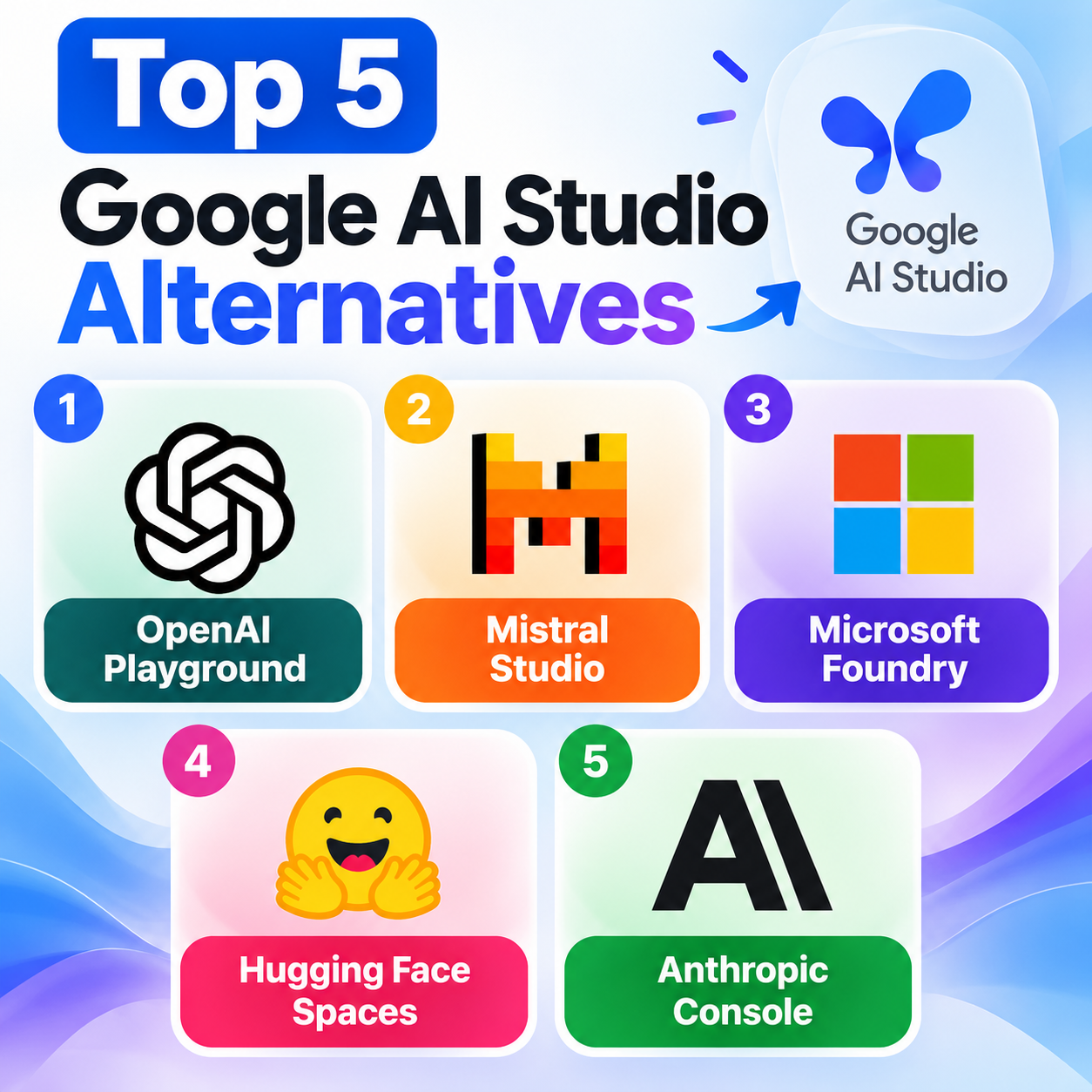
Google AI Studio is a popular environment for experimenting with Gemini models, testing prompts, managing API access, and building AI prototypes. Google AI for Developers If you want similar functionality outside the Google ecosystem, these five platforms are worth considering.
1. OpenAI Playground is one of the closest alternatives to Google AI Studio for developers who want to experiment with frontier models before building an application. It supports prompt development, conversational testing, image and file inputs, web search, file search, function calling, and agent development. OpenAI Platform A major advantage is the broader OpenAI platform ecosystem: experiments can move into the Responses API and agent tooling when you’re ready for production. OpenAI also provides multiple model tiers for different reasoning, performance, and cost requirements. OpenAI Platform Best for: Developers building applications around OpenAI models.
2. Mistral Studio provides a developer-focused environment for testing and deploying Mistral models. Its Playground lets you test prompts, compare models, adjust parameters, manage API keys, and experiment without writing code. Mistral AI Documentation It goes beyond simple chatbot experimentation with capabilities for agents, document intelligence, RAG, embeddings, audio, connectors, and batch processing. Mistral also emphasizes enterprise privacy and control over data. Mistral Best for: Developers interested in Mistral models, agents, RAG, and enterprise AI.
3. Microsoft Foundry is particularly useful if you want access to multiple AI providers from one platform. Its model catalog includes models from OpenAI, Anthropic, Meta, Mistral, DeepSeek, Cohere, and others. Microsoft Learn Its Playgrounds support prompt engineering, model comparison, parameter tuning, web search, file search, code execution, agent prototyping, evaluations, and code export. Microsoft Learn Best for: Businesses and developers who want a multi-model, enterprise-oriented platform.
4. Hugging Face Spaces takes a more open-source and community-driven approach. You can build and host AI demonstrations using technologies such as Gradio, Docker, and static HTML, with access to GPU-backed infrastructure. Hugging Face Rather than focusing solely on one model provider, Spaces gives you access to a huge ecosystem of models and ready-made AI applications, covering text, images, video, speech, coding, OCR, and more. Hugging Face Best for: Open-source experimentation, demos, and discovering AI models.
5. Anthropic Console developer platform is another strong alternative for experimenting with Claude models and building production applications. It is particularly relevant for developers focused on advanced language-model applications, coding, reasoning, and agentic workflows. Best for: Developers specifically interested in Claude and Anthropic’s ecosystem.
Bottom line
The choice depends largely on your workflow: OpenAI Playground for OpenAI development, Mistral Studio for Mistral’s ecosystem, Microsoft Foundry for multi-model enterprise development, Hugging Face Spaces for open-source experimentation, and Anthropic’s platform for Claude-focused development.
Leave a Reply