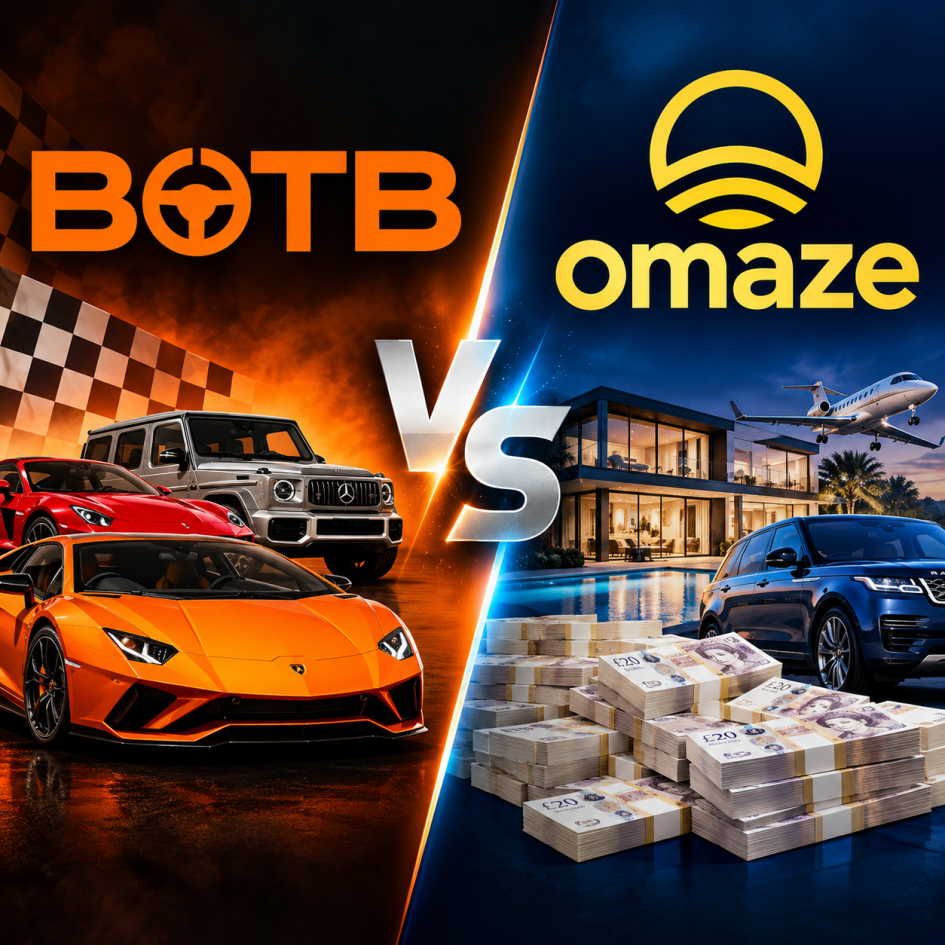
BOTB is heavily focused on cars and luxury prizes, while OMAZE is primarily known for large cash prizes and luxury experiences/homes, often with a charitable angle.
BOTB is particularly attractive if your dream prize is a specific high-end car. Its competitions commonly feature sports cars, supercars and other desirable vehicles. The appeal is straightforward: you enter a competition for the chance to win the featured car rather than receiving a cash equivalent.
One distinctive element is that BOTB competitions traditionally involve a skill-based spot-the-ball game. You aren’t simply selecting numbers and hoping a random draw goes your way. You have to identify where you think the ball should be in a football photograph. That makes BOTB feel more like a competition than a conventional lottery-style draw.
The downside is that the format can make it harder to assess your odds intuitively. Your success depends partly on how accurately you perform the skill element and, depending on the specific competition, how your entry compares with others.
OMAZE has a much broader prize proposition. Its UK competitions have featured multi-million-pound cash prizes, luxury homes, cars, holidays and experiences. A major selling point is that many OMAZE campaigns are associated with charitable fundraising, with a portion of proceeds going to charity.
For someone who doesn’t specifically want a supercar, OMAZE is arguably more flexible. Winning several million pounds, for example, gives you the freedom to buy whatever house, car or lifestyle you want rather than being committed to the particular prize advertised.
OMAZE competitions generally feel more like prize draws than skill competitions. That makes the experience simpler, but you’re essentially relying on chance rather than your performance in a game.
My take: If your goal is “I really want to win a particular supercar,” BOTB is the more interesting proposition. If your goal is “I want the biggest possible lifestyle-changing prize,” I’d lean toward OMAZE.
However, neither should be viewed as an investment. The expected financial return of repeatedly entering is generally negative; you’re paying for entertainment and the small possibility of winning something dramatically more valuable than your entry.